Autonomous solutions

Supporting patient safety through real individualised care.

Read more about how the solutions work

The healthcare is under pressure

The demand for healthcare is growing, patients are becoming more complex, and workload continues to increase. At the same time, healthcare organisations face ongoing staffing challenges.

This raises an important question:

How do we create systems that remain safe and effective even when healthcare professionals are working under pressure?


The risk of relying on manual routines for patient safety

Many pressure redistribution systems are described as automatic.

However, clinical performance often remains dependent on routine checks, manual assessments and correct adjustments by healthcare professionals.

More than half of air mattress systems in clinical use were incorrectly adjusted.
Three out of four patients in a seated position were at risk of insufficient pressure redistribution and potential bottoming out.*

When the right outcome depends on someone remembering to perform the correct intervention at the correct time, variation becomes inevitable.

The challenge is not healthcare professionals. The challenge is systems that rely on people never missing a step.

* Ward C. Journal of Tissue Viability 2010

Automatic is not the same as autonomous

An automatic function can perform a task. An autonomous system takes responsibility for the outcome.

Many automatic systems:

  • Operate from preset parameters
  • Require ongoing monitoring
  • Depend on manual intervention
  • Deliver the correct result only when someone performs the correct action

Autonomous systems are fundamentally different. They continuously adapt to the patient’s actual needs in real time and maintain performance despite changing conditions.

What is autonomy in pressure redistribution?

Autonomy is not a specific feature. It is a way of designing systems.

An autonomous mattress system continuously adapts pressure redistribution and pressure relief based on the patient’s current situation. The system responds when:

  • The patient’s position changes – turning, sliding, or sitting upright.
  • Pressure conditions change – due to bed adjustments, oedema, or bedside care.
  • Clinical needs evolve – because of changes in circulation, weight, or mobility.

Rather than relying on preset values, the system continuously works to provide support based on the individual’s needs here and now.

The impact of autonomous systems

For patients

International pressure injury prevention guidelines emphasise the importance of individualised prevention and treatment strategies. Autonomous systems support this by continuously adapting to each patient’s situation.

Benefits may include:

  • Individualised pressure redistribution
  • Reduced risk of inappropriate support
  • More consistent patient safety
  • Better conditions for pressure injury prevention

For healthcare professionals

Autonomous systems help reduce the need for repeated checks, adjustments and follow-up activities.

This can contribute to:

  • Less technical workload
  • Fewer manual interventions
  • Greater confidence in mattress performance
  • More time for patient care and clinical assessment

For healthcare organisations

Autonomous systems can help reduce variation between departments, teams and individual caregivers.

Potential benefits include:

  • More consistent care quality
  • Better utilisation of healthcare resources
  • Reduced dependence on local routines
  • Improved long-term efficiency

From functions to outcomes

For many years, pressure redistribution technology has been evaluated based on functions and features.

But patients do not experience features. They experience outcomes.

The future of pressure injury prevention is therefore not about adding more controls. It is about reducing the need for controls.

Not by removing healthcare professionals from the process, but by designing systems that continuously support them and help maintain patient safety regardless of workload, staffing levels or time of day.


Our autonomous solutions

CuroCell® IQ

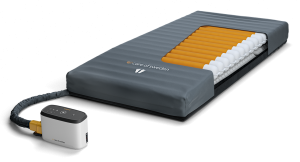
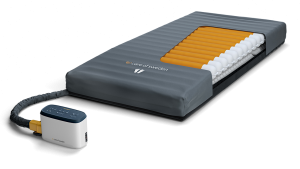
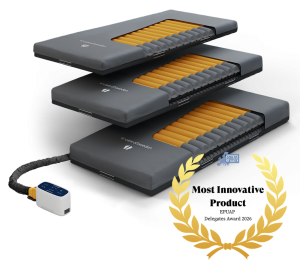
CuroCell® IQ is a fully autonomous mattress system that adapts internal pressure according to the individual’s weight, height and position.

Learn more about CuroCell® IQ

Dynamic mattress system

CuroCell® A4

CuroCell® A4 combines the autonomous pressure adjustment with a choice of pressure-redistribution modes, CLP (Constant Low Pressure), GALP (Gentle Alternating Low Pressure)  or Pulsating Mode™. 

Learn more about CuroCell® A4

Dynamic mattress system

CuroCell iA®

CuroCell iA® combines the autonomous pressure adjustment with a choice of pressure-redistribution modes, CLP (Constant Low Pressure), GALP (Gentle Alternating Low Pressure).

Learn more about CuroCell iA®